






Rise & fall of Chettiar merchants
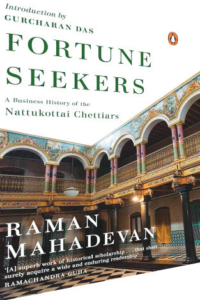 Fortune seekers: a business history of the nattukottai chettiars
Raman Mahadevan
Penguin random house
Rs.599
Pages 243
This potrayal of the Chettiars recounts how they utilised the opportunities of the 19th century, and their era of great prosperity and subsequent decline
This book on the Nattukottai Chettiars is the fifteenth in the Penguin series on the Story of Indian Business and fifth of the books on business communities. The notion of a business community itself seems an anachronism leading to the question of its relevance in modern times and changing economic landscapes. Gurcharan Das, the series editor, highlights the comparative advantage that a traditional business community/caste has in adapting to the prevailing market-based international economic order, while also acknowledging that it is limited by time and space.
The Nattukottai Chettiars or Nagarattar are the most prominent of the business communities of South India. In Tamil Nadu, the Chettiars are synonymous with business success, entrepreneurship and adaptability. Families like the Raja Sir Annamalai Chettiar with their business empire starting with the Indian Bank founded in 1907; the AMM group which is among the largest conglomerates in India today; AV Meyyappa Chettiar (AVM Studios) as well as names like M CT Chidambaram Chettiar who started the Indian Overseas Bank (1937), reinforce the popular perception of a community that has reinvented itself and made a smooth transition into the modern business world.
Raman Mahadevan’s intensive, though short, portrayal of the Nattukottai Chettiars recasts these general assumptions. Tracing their commercial activities from around 1800, he recounts how their sharp business acumen utilized the opportunities and challenges of the 19th century and their era of great prosperity and subsequent decline. Sadly their time-honoured social cohesiveness has weakened in the changing economic and political environment of the 20th century.
The region known as Chettinad is located in Ramanathapuram and Pudukottai districts, where nine exogamous clans of Chettiars live in a few towns and 78 villages. The nine clan temples (supported by a compulsory contribution from each household), the joint family (unique in that each married member lives as a nuclear family in one large mansion), and the family firm (where all family members were partners with the oldest male member as the deciding authority) were the three pillars of Chettiar society.
Traditionally, Chettiars were traders who dominated the salt and rice trade. By 1800, their trade network had extended to interregional trade in rice which extended from Calcutta to Sri Lanka. They also diversified into banking, probably to enable them to conduct money exchange to finance inter-regional trade.
The 19th century was a period of significant political and economic change which propelled Chettiar businesses to a different plane altogether. In the early 19th century, local zamindars unable to pay land revenue dues to the Madras Government resorted to borrowing from Chettiars and many ultimately lost their lands which were forfeited when they could not pay back their loans. Thus, Chettiars became landowners on a large scale in the southern districts. This in fact was the business model followed by Chettiar firms as they expanded their activities from Sri Lanka (where they had trade interests well before British rule) into Malaysia and Burma and even further east to Southeast Asia. All drew on intra-community resources of capital.
There was exponential expansion of the business activity of the Chettiars overseas from the 1850s due to push and pull factors. Industrial growth in the West generated a continued and almost insatiable demand for raw materials to feed their factories, and trade flourished after the opening of the Suez Canal in 1869. This led to a significant growth in the production of raw materials from plantations, agriculture and mining in Sri Lanka, Burma, Malaysia and further east. The Chettiar merchants built their fortunes on the trade of these products and providing finance to these businesses.
As an outsider reading this detailed account of the halcyon days when fortune smiled on the Chettiars, I experienced a feeling of déjà vu wondering whether this balloon would burst. And the collapse came in the 20th century. The depression of the 1930s was the first serious blow. While the larger business houses were able to stay afloat, medium and small firms suffered near collapse.
Next came World War II and the Japanese invasion. After the War, the British left, colonial rule ended, and the former colonies witnessed the rise of assertive nationalism. These adverse circumstances virtually ended the hegemony enjoyed by the Chettiars in Burma, Malaysia and Sri Lanka.
The Chettiars now had to return to their home base in a changed economic world. In their heyday, gentlemen Chettiar families built grand, opulent mansions in Chettinad and the East, living testimony of their past. But relatively few made the transition to modern industrial enterprises and organizations. Mahadevan points out that a few far-sighted Chettiar families did enter textile manufacture, leather, etc, but most of these could not be sustained. Even well-known names like the M CT family, Alagappa Chettiar, and many others faded from the scene in the last century.
This brief overview does little justice to the scholarship and depth of the detailed account that Mahadevan presents of dozens of Chettiar families listed by name along with their business details. The question that is never fully answered is why other Chettiars could not follow the path of the AMM group (for instance) and succeed in today’s business world. One explanation the author offers is that community linkages weakened, especially after the setbacks following the Depression, and lower and middle-income Chettiar families opted for white-collar professional jobs.
Or, is it possible that after successfully exploiting the free-wheeling, high-profit commercial prospects of the earlier century, the community was not able to penetrate the competitive, capitalist environment of the 20th century? Nevertheless, with the publication of this book, Chettinad history is available to a wider readership in India.
Kanakalatha Mukund
(The Book Review)










Add comment