






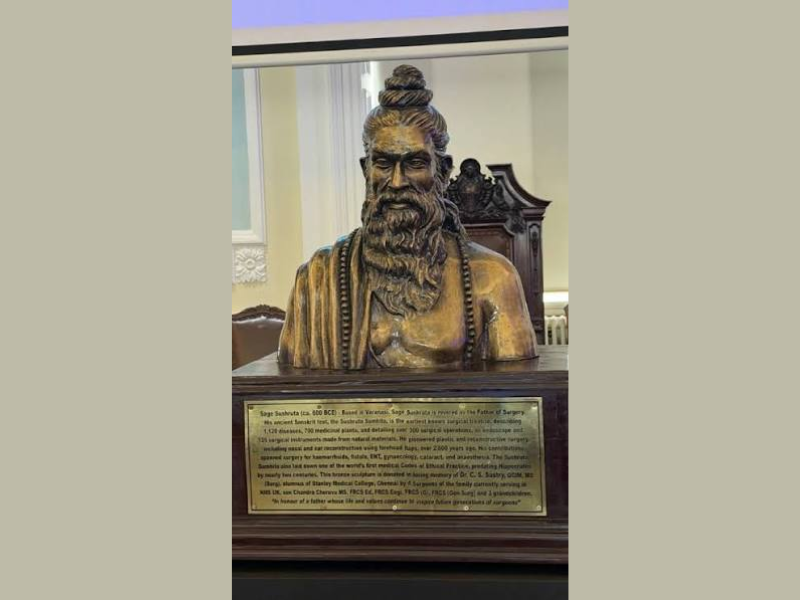
Statue of Maharishi Sushruta unveiled at Royal College of Surgeons of Edinburgh
In a landmark recognition of India’s ancient medical heritage, a bronze statue of Maharishi Sushruta, widely regarded as the “Father of Surgery,” has been unveiled at the Royal College of Surgeons of Edinburgh (RCSEd) in Scotland.
The installation of the statue at one of the world’s oldest and most prestigious surgical institutions marks a significant acknowledgement of Sushruta’s contributions to the evolution of surgical science. The unveiling ceremony celebrated the deep historical links between India and Scotland in the fields of medicine and surgery.
Maharishi Sushruta, believed to have lived in ancient India more than 2,500 years ago, is renowned for authoring the Sushruta Samhita, a foundational text of surgery that documented hundreds of surgical procedures, instruments, and medical techniques. He is particularly known for pioneering reconstructive and plastic surgery methods, including rhinoplasty, centuries before such procedures became established in Europe.
The statue was installed as part of a philanthropic initiative led by UK-based surgeon Professor Chandra Cheruvu and his family. Alongside the sculpture, the Cheruvu Family Professional Development Grants were launched to support international training and educational opportunities for surgeons and medical professionals. According to the Royal College, the initiative seeks to honour the legacy of Sushruta while investing in the next generation of healthcare leaders.
Officials at the Royal College described the sculpture as a tribute to one of the earliest pioneers of surgery whose teachings continue to influence medical practice globally. The statue has been placed within the College’s heritage collection, reinforcing the institution’s recognition of the global origins and development of surgical knowledge.
The Royal College of Surgeons of Edinburgh, established in 1505, is among the oldest surgical institutions in the world and has played a pivotal role in advancing surgical education and standards internationally.
The unveiling has been widely welcomed as a moment of pride for India, highlighting the enduring relevance of its ancient scientific and medical traditions on the global stage. The event also serves as a reminder of the contributions of non-Western civilizations to the history of medicine and surgery.
Also Read: Several Stanford students stage walkout as Sundar Pichai begins speech








Add comment