






– GEMS Education
By creating student roles around voice, wellbeing, creativity and shared responsibility, schools can help young people experience leadership as empathy in action.
Who is a leader?
The student who speaks the loudest? The one who wins the most votes? The one wearing the most prominent badge?
Or could leadership also belong to the child who notices an unheard voice, recognises that someone feels unsafe, creates space for a different idea, or asks whether a system is working equally well for everyone?
This question shapes the approach to student leadership across GEMS schools.
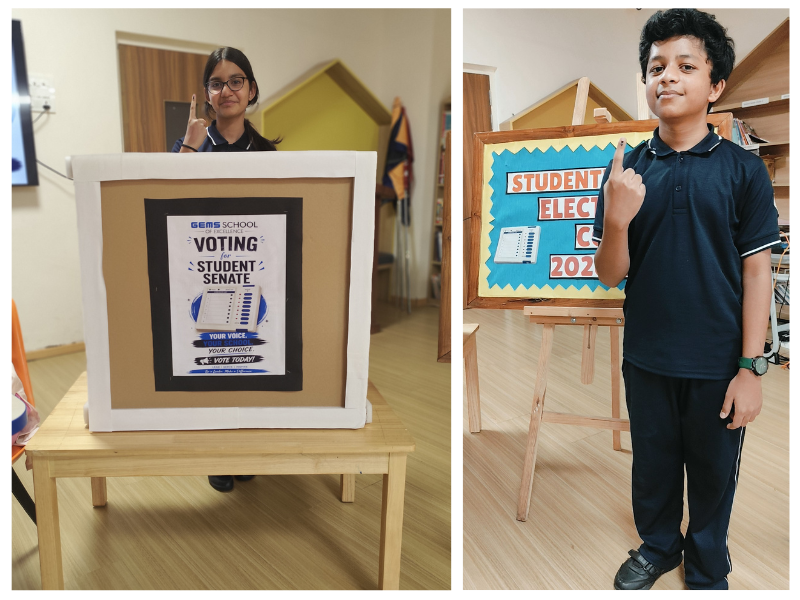
Students experience the democratic process through nominations, campaigning and a secret ballot. But the election is only the beginning. The more important question is: What are students being elected to do?
“Democracy becomes meaningful only when young people understand that voice must be accompanied by responsibility,” says Francis Joseph, CEO, GEMS Education India. “Schools must help children experience that relationship early.”
Designing leadership around the society we want
Traditional student councils often concentrate leadership in a few familiar positions. At GEMS schools, the intent is to widen both its definition and its purpose through roles such as Voice Executives, Wellbeing Executives and Creativity Ambassadors.
Voice Executives help surface perspectives that may otherwise remain unheard. Wellbeing Executives notice concerns around safety, inclusion and belonging. Creativity Ambassadors create opportunities for new ideas and encourage participation beyond the most visible or confident voices.
These roles are deliberately designed around the qualities a diverse society needs: empathy, respect for differing perspectives, inclusion and the ability to see beyond one’s own experience.
Leadership, then, is not simply about speaking on behalf of others. It is about listening closely enough to understand them.
When student voice becomes student ownership
This philosophy becomes meaningful when students are trusted with real responsibilities rather than ceremonial titles.
A student-led safety audit is one example. Members of the Student Senate, together with other students and senior teachers, examine their own school environment. They observe safety provisions, identify concerns and contribute recommendations.
The value of the exercise lies beyond completing a checklist. Students must consider experiences different from their own. A space that appears safe to an older student may feel very different to a younger child, a student with a disability or someone who is hesitant to express discomfort.
In that moment, safety becomes connected with empathy. Observation becomes responsibility. Feedback becomes participation.
Students are also guided by defined responsibilities and standards of conduct. Their positions are therefore not rewards for popularity, but commitments that require consistency, accountability and service.
Learning to respect the other
Children are exposed to competing opinions, public disagreement and political debate long before they have the tools to evaluate them. Schools can help build those tools by giving them meaningful opportunities to listen, question and participate.
Can I disagree without dismissing another person? Can I notice whose perspective is missing? Can I use my influence to make space for someone else? Can I question a system constructively and help improve it?
These are democratic habits. They are also human ones.
Not every child will hold public office. Every child, however, will become part of a society shaped by institutions, choices and differing points of view.
Democracy needs confident voices. But it also needs empathy, curiosity and respect for the other.
That is why the most meaningful leaders may not always be those who speak first.
They may be the ones who first choose to listen.
Also Read: GEMS Education: When Empathy Leaves the Room, Peace Leaves With It








Add comment