






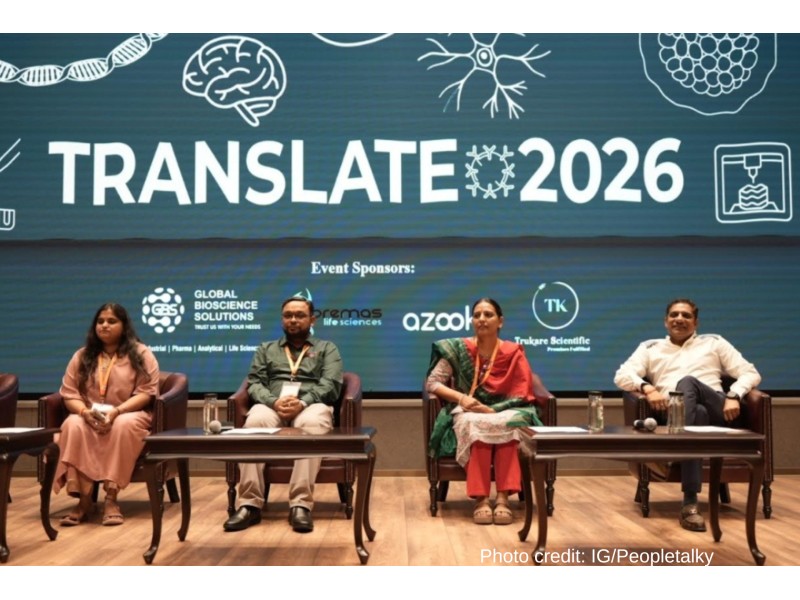
Manipal Institute of Regenerative Medicine Hosts TRANSLATE 2026 on Translational Biomedical Research
Manipal Institute of Regenerative Medicine (MIRM), a constituent unit of Manipal Academy of Higher Education (MAHE), organised TRANSLATE 2026, a two-day symposium dedicated to advancing translational biomedical research and accelerating the transition of laboratory discoveries into patient-focused healthcare solutions.
Supported by the Anusandhan National Research Foundation (ANRF), the symposium brought together scientists, clinicians, medtech startups, healthcare innovators, and industry leaders to discuss how emerging biomedical technologies can be transformed into scalable, clinically relevant, and commercially viable healthcare solutions.
The event highlighted the increasing need for patient-centric and technology-driven healthcare innovations, while emphasising the importance of stronger collaboration among academia, hospitals, startups, and industry. Experts noted that many major healthcare advancements today are driven by interdisciplinary partnerships that bridge scientific research with clinical and commercial applications.
Inaugurating the symposium, Prof. Madhu Veeraraghavan, Pro Vice Chancellor of MAHE Bengaluru, said that while Artificial Intelligence is rapidly reshaping healthcare and research, real innovation depends on effectively translating scientific knowledge into meaningful patient outcomes. He added that platforms like TRANSLATE 2026 reflect MAHE Bengaluru’s commitment to strengthening collaboration between academia, clinicians, and industry to accelerate healthcare innovation.
The symposium featured discussions on emerging fields shaping the future of healthcare, including advanced biomaterials, regenerative medicine, tissue engineering, 3D and 4D bioprinting, infection-resistant medical surfaces, and translational medical devices. Sessions explored how next-generation biomaterials and regenerative technologies are opening new possibilities in implant technologies, regenerative therapies, and biomedical devices aimed at improving patient care.
Industry leaders and startups also played a key role in the event, sharing insights into the challenges of converting healthcare research into commercially successful and clinically deployable technologies. Discussions further focused on strengthening indigenous medtech innovation, expanding healthcare manufacturing ecosystems, and improving pathways for clinical adoption.
Speaking on the significance of the symposium, Prof. Jyothi Prasanna said TRANSLATE 2026 was conceived as a collaborative platform where researchers, clinicians, innovators, and industry leaders could collectively work towards translating scientific discoveries into impactful healthcare solutions. She emphasised that the future of regenerative medicine and biomaterials research lies in interdisciplinary collaboration capable of delivering socially relevant and clinically meaningful innovations.
By bringing together experts from science, healthcare, technology, and entrepreneurship, TRANSLATE 2026 reinforced MAHE Bengaluru’s growing role in promoting translational biomedical research and supporting India’s ambitions in medtech innovation, regenerative medicine, and advanced healthcare technologies.
Also read: Global Young Scholar platform launched in India for 2026 academic year










Add comment