






Sustainable Excellence: Manipal Academy of Higher Education’s Guide to Quality
As India’s first private university to be recognized as an Institute of Eminence (IoE), Manipal Academy of Higher Education (MAHE) is not only known for its academic legacy but also for its relentless pursuit of institutional quality. This pursuit is guided by a 15-year strategic plan, segmented into three five-year phases, designed to place MAHE among the top 100 globally ranked institutions.
The path to global excellence is defined by measurable objectives and outcomes across academics, research, internationalisation, alumni and collaborations, and infrastructure. However, progress along these trajectories holds little value if it is not achieved in compliance with the highest standards of sustainability and quality.
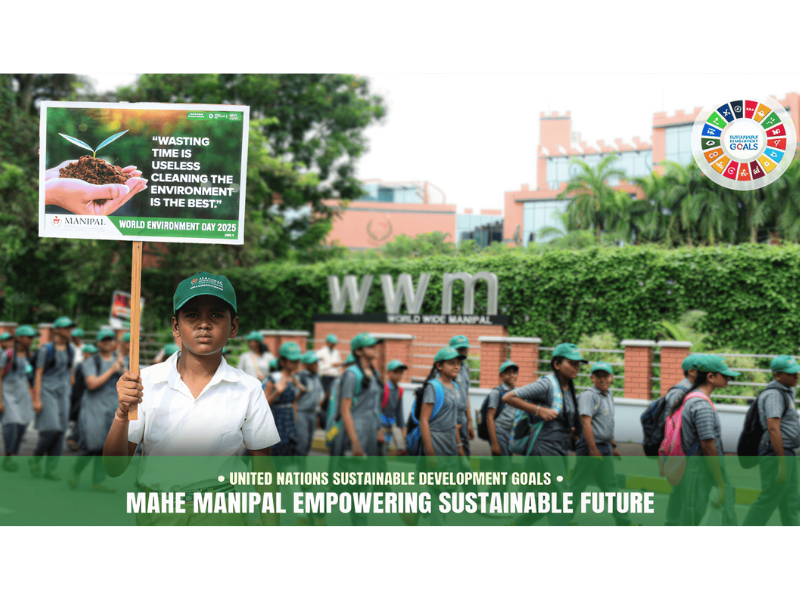
Sustainability at MAHE is not a separate agenda but an intrinsic part of its institutional culture, aligning directly with the United Nations Sustainable Development Goals (SDGs). From energy-efficient buildings and waste management systems to water recycling and green energy adoption, sustainability practices permeate daily operations across campuses. These efforts support the institute’s goal of achieving net-zero emissions by 2040.
These initiatives have received international recognition, with MAHE securing top national and notable global positions in sustainability-focused rankings. Guided by dedicated policies, standards such as ISO 14001 and ISO 50001, and annual audits, the university ensures accountability and transparency. The impact of these initiatives is showcased through MAHE’s sustainability portal, which highlights projects, partnerships, and rankings. This integrated approach ensures that sustainability and academic excellence advance hand in hand.
For its efforts, the UI GreenMetric World University Ranking has placed MAHE 1st in India and 121st globally, while the QS Sustainability Rankings have improved its global position from 576 to 401, ranking it 9th in Asia.
MAHE’s reputation for academic excellence is firmly underpinned by its commitment to securing and sustaining top-tier accreditations, including ISO certifications and the prestigious NAAC A++ grade. These accreditations reflect the institute’s rigorous standards in maintaining the quality of education, research, infrastructure, and faculty.
MAHE also plays a proactive role in advancing its global standing through ethical, accurate, and transparent data reporting to ranking bodies such as Quacquarelli Symonds (QS) and Times Higher Education (THE). The Department of Quality and Compliance continuously identifies areas for improvement, aligns institutional practices with global benchmarks, and ensures that every achievement contributes meaningfully to MAHE’s global ambitions.
In tandem with the central Department of Quality and Compliance, institutional quality management teams regularly engage in policy discussions and decision-making. This ensures that best practices are shared, and compliance is viewed not as a formality but as a pathway to institutional growth. This model, often likened to a wheel and its spokes, empowers individual institutes while maintaining the coherence and integrity required to uphold academic and global ambitions.
Sustainability at MAHE extends beyond environmental initiatives to include social responsibility and institutional continuity. Embedded values of gender equity, inclusion, and non-discrimination contribute to building a sustainable educational ecosystem through policies and practices that create a supportive learning environment for all.
Equal opportunity is not merely advocated but actively practiced, fostering a truly diverse and merit-driven environment. The success of this approach is evident in MAHE’s strong graduate employability and the achievements of its global alumni network, many of whom occupy leadership roles across industries and academia. These outcomes reaffirm MAHE’s standing as a premier institution delivering quality education with a deep and lasting societal impact.
Sustainability is not only about environmental responsibility but also about creating an ecosystem of shared strategic priorities and collaborative frameworks that promote responsible growth. Inter-campus academic audits and rigorous internal review mechanisms enable MAHE’s quality journey to progress continuously, like a well-oiled machine driving sustained improvement across its institutions.
Looking ahead to Vision 2040, MAHE is confidently moving toward its goal of becoming one of the world’s top 100 universities. This ambition is supported by robust strategies, transparent evaluation processes, and a collaborative institutional culture.
As articulated by the Quality Office, “We don’t create the stories; we collect and share them. Quality isn’t a checkbox—it’s a way of life at MAHE.” This mindset ensures that quality remains deeply embedded in every aspect of institutional life, now and into the future.
Also Read: MAHE: Visionary leadership that enables continuous transformation and empowerment







Add comment